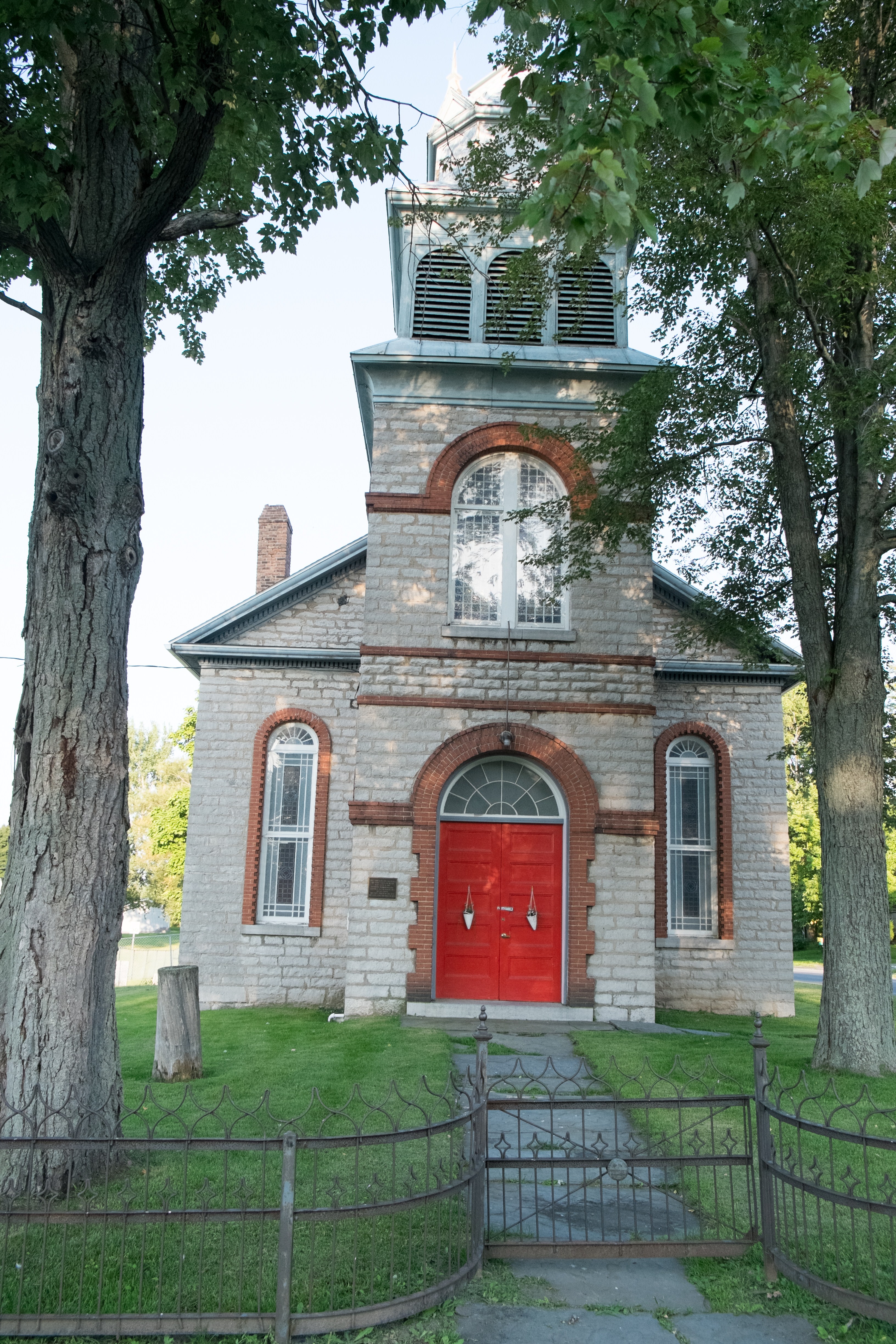
Dave and I had the amazing blessing of taking a Church history tour last week
of Palmyra, New York then down to Kirtland, Ohio.
Our first stop was the Hill Cumorah!
This was a magical trip full of the most beautiful sites I've seen!
From LDS.org...
Introduction
The golden plates containing the Book of Mormon were buried in the Hill Cumorah, about three miles southeast of the Smith family farm. In the early hours of September 22, 1823, the angel Moroni showed Joseph Smith in vision exactly where the ancient record was hidden. Later that day, Joseph went to the place shown him by the angel.
"On the west side of this hill, not far from the top, under a stone of considerable size, lay the plates, deposited in a stone box,"1 wrote Joseph. He was not permitted to remove the plates on his first visit, but was instructed by the angel to return to this place every year "until the time should come for obtaining the plates."2 Exactly four years later, the angel delivered the plates to the Prophet Joseph for the purpose of translation and publication.
The Church of Jesus Christ of Latter-day Saints acquired the Hill Cumorah in 1928. A granite monument topped by a nine-foot statue of Moroni was erected at the highest point of the hill in 1935. Today, the Church operates a modern visitors' center at the base of the hill. A dramatic pageant featuring events from the Book of Mormon is held here every summer.
Quotes
Joseph Smith Quotes
Convenient to the village of Manchester, Ontario county, New York, stands a hill of considerable size, and the most elevated of any in the neighborhood. On the west side of this hill, not far from the top, under a stone of considerable size, lay the plates, deposited in a stone box. (Joseph Smith—History 1:51.)
The messenger . . . told me that I should come to that place precisely in one year from that time, and that he would there meet with me, and that I should continue to do so until the time should come for obtaining the plates.
Accordingly, as I had been commanded, I went at the end of each year, and at each time I found the same messenger there, and received instruction and intelligence from him at each of our interviews, respecting what the Lord was going to do, and how and in what manner his kingdom was to be conducted in the last days. (Joseph Smith—History 1:53–54.)
At length the time arrived for obtaining the plates, the Urim and Thummim, and the breastplate. On the twenty-second day of September, one thousand eight hundred and twenty-seven, having gone as usual at the end of another year to the place where they were deposited, the same heavenly messenger delivered them up to me with this charge: that I should be responsible for them; that if I should let them go carelessly, or through any neglect of mine, I should be cut off; but that if I would use all my endeavors to preserve them, until he, the messenger, should call for them, they should be protected. (Joseph Smith—History 1:59.)
Witnesses
Emma Smith, Wife of the Prophet Joseph Smith
The plates lay in a box under our bed for months and on the [table in our home] without any attempt at concealment, wrapped in a small linen table cloth, which I had given him to fold them in. I once felt . . . the plates as they thus lay on the table, tracing their outline and shape. They seemed to be pliable like thick paper, and would rustle with a metallic sound when the edges were moved by the thumb, as one does sometimes thumb the edges of a book. ("Last Testimony of Sister Emma," The Saints' Herald, Oct. 1, 1879, 290.)
Thomas S. Monson, Apostle, 1963–2018
What a privilege to be here at the Hill Cumorah and to reflect on the momentous events that unfolded on September 22, 1827, when a plowboy prophet took a horse and wagon and, in the dark of night, rode to this hill, where he received an ancient record from the angel Moroni. In a remarkably short time, this untutored young man translated a record detailing 1,000 years of history and then prepared the Book of Mormon for public distribution. . . .
. . . The visitor often comes with an attitude of curiosity. He or she departs with a soul touched by the Spirit of the Lord. . . .
. . . I bear an apostolic witness that Jesus is the Savior of the world and that He and His Father appeared to the Prophet Joseph Smith to usher in this dispensation of the fulness of times. ("Special Witnesses of Christ," Ensign, Apr. 2001, 19–20.)
Key Events
Revelations Received
No revelations recorded in the Doctrine and Covenants were received at this site. —
Our second stop on the trip was at the E.B. Granin Press where the first printing of the Book of Mormon was printed.
This is a neat building and one of the few that has the original floor boards.
It was the "Barnes and Noble" of it's day.
An original copy of the Book of Mormon
This is a neat sign that shows the languages and the order that they were translated.
Alvin's grave is located in the cemetery just around the corner from here.
Alvin is Joseph's older brother who died of what they think was a ruptured appendix.
From LDS.org...
The Prophet Joseph Smith called the Book of Mormon the “keystone of our religion.”1It is not only evidence of Joseph Smith’s prophetic call, but it is also a testament of the reality and divinity of Jesus Christ. Together with the Bible, it witnesses that “Jesus is the Christ, the Eternal God, manifesting himself unto all nations.”2 It was this very printing press that issued the first copies of the Book of Mormon in 1830.
Now on display at the Church History Museum, this printing press came from the shop of Egbert B. Grandin in Palmyra, New York. Modern for its time, the Smith Patented Improved Press greatly simplified the printing process and allowed the pressman to make an impression with one pull of a lever. Without this press, it is unlikely that Grandin would have been able to take on such a large printing job as the Book of Mormon.
Joseph Smith made arrangements to print the Book of Mormon in 1829, before the translation was complete. He secured a copyright and contacted several printers. Ultimately, Grandin agreed to print 5,000 copies for a cost of $3,000.3
In 1829, a print run of 5,000 copies was extremely large. By comparison, the first edition of Nathaniel Hawthorne’s classic The Scarlet Letter was only 2,500 copies.4 In order to finance such a large printing job, Martin Harris mortgaged part of his farm and later sold 151 acres of his property to cover some of the costs.5
After making these arrangements, Joseph returned home to Harmony, Pennsylvania, leaving his brother Hyrum and Oliver Cowdery to supervise the printing. Joseph was concerned about the security of the manuscript, having lost 116 pages earlier in the translation process when he let Martin Harris borrow them. Joseph’s mother recorded the measures they took to safeguard the manuscript during the printing:
Joseph . . . received a commandment which was in substance, thus: First, that Oliver Cowdery should transcribe the whole of the manuscript. Second, that he should take but one copy to the office at a time; so that, if one copy should be destroyed, there would still be a copy remaining—Third, that, in going to and from the office, he should always have a guard to attend him for the purpose of protecting the manuscript.—Fourth, that a guard should be kept constantly on the watch, both night and day, about the house, to protect the manuscript from malicious persons, who would infest the house for the purpose of destroying it. All these things were strictly attended to, according to the commandment.6
The copy that Oliver made is called the printer’s manuscript, and it was used in setting the type. The original copy remained at the Smith home for safekeeping. Hyrum visited the printer almost daily to oversee the work.7
The printing process at that time was slow and labor-intensive. A typesetter had to place each letter into a tray by hand. These lines of type were transferred to a form that, in the case of the Book of Mormon, included eight pages.8 To complicate matters, the original manuscript included no punctuation or paragraphing. Hyrum permitted the typesetter to add the punctuation and paragraphing himself.9 Oliver was also allowed to help with the typesetting.10
Once each letter and punctuation mark was in place, “the type was inked, and large sheets of paper were placed in a frame and positioned over the type. Pulling on a lever lowered the heavy iron plate onto the paper and type. This process was repeated five thousand times, and each sheet was hung up to dry.” Then the process was repeated for the reverse side of those sheets. “The resulting sixteen pages were folded and sewed into the book and trimmed to size when it was bound.” The 16-page unit is called a signature. The Book of Mormon included about 35 signatures.11
According to one study, “it took eleven hours a day, six days a week, excluding Sundays and holidays, for nine months” to print the 5,000 copies of the first edition. At nearly 600 pages per copy, that is nearly 3,000,000 pages.12
Finally, the Book of Mormon was ready. On March 19, 1830, a Palmyra newspaper ran an advertisement that said, “We are requested to announce that the ‘Book of Mormon’ will be ready for sale in the course of a week.” A week later, another advertisement announced that the Book of Mormon was for sale.13
Missionaries took these first copies of the Book of Mormon to neighboring towns and regions. Passed from one hand to another, the Book of Mormon was eventually instrumental in converting thousands to the Church in the United States and Europe.
President Joseph F. Smith purchased this press in 1906 as part of his efforts to preserve the heritage of the Church. A replica of the press is also on exhibit at the Book of Mormon Historic Publication Site in Palmyra, New York.
Today, the Book of Mormon is translated into 82 languages, and more than 150 million copies have been printed.14 Millions of people throughout the world can add their testimony that the Book of Mormon is the word of God and that Joseph Smith truly was a prophet.
This is the home the entire Smith family lived in when the First Vision
happened. The Sacred Grove is located just behind this home.
This is the upstairs bedroom where the Angel Moroni appeared to Joseph, 3 times in one night.
This is the home that the Smith's lived in a few years later. It's just down the road from the original home. When the Smith's moved in to this home, Hyrum and his family lived in the old home.
This is the cooper building where they would make barrels
This is the fireplace where Joseph hid the plates under the brick when he was being chased by a mob after he obtained the plates with Emma.
Of course, the main reason I wanted to go on this trip was so I could have the chance of a lifetime of seeing the Sacred Grove in person! Let me tell you, it did not disappoint!
After we had the tour of the Smith family farm, we got to walk through the Grove.
Wednesday morning we headed out to Fayette, NY to see the Peter Whitmer Farm.
This is where the prophet went with Oliver Cowdry (who was friends with the Whitmer's)
and translated some of the Book of Mormon.
It was also here where the church was first organized on April 6, 1830.
From LDS.org...
The Whitmer Farm in Fayette, New York
Over the past 100 years, almost every session of general conference has been held in Salt Lake City, Utah. The only exception came in 1980, when a session of conference was broadcast instead from a small, commemorative log home on a 100-acre farm in Fayette, New York. That spring, the Church looked back to remember the place where it had been organized a century and a half before, on April 6, 1830. Before there were temples, tabernacles, or meetinghouses, believers had gathered in a home where God’s work was welcome.
Today, Church members can still visit the farm where Mary and Peter Whitmer Sr. supported the Book of Mormon translation, hosted the newborn Church, and witnessed some of Joseph Smith’s earliest revelations. On this land, some of the foundational events of the Restoration unfolded and some of the first Saints gained testimonies of God’s latter-day work.
The Whitmers in New York
In the first decades of the 19th century, almost everyone in western New York was a recent arrival. Many families in the area—and by extension in the early Church—came to the area from parts of New England that were mostly settled by English immigrants.1 The Whitmers, in contrast, were part of the German immigrant community in Pennsylvania before they moved to New York in the first decade of the 1800s. Mary Musselman Whitmer, the matriarch of the family, had been born in Germany.2
In Fayette, the Whitmers worked a 100-acre farm and built improvements on the land to meet the needs of their growing family. By the time they made the final payment on the farm in 1819, Peter Sr. and Mary had five sons and two daughters living at home.3
The Whitmers were a tight-knit family brought up with a strong sense of Christian discipline. They were involved in the civic and religious affairs of their community. Mary Whitmer participated with other Pennsylvania Germans in the local congregation of the German Reformed Church. At the “old Zion’s church” in town, Reverend Diedrich Willers baptized the three adult Whitmer sons on April 5, 1822. Years later, Reverend Willers remembered Peter Whitmer Sr. as a “plain, unassuming farmer” and a “quiet, unpretending, and apparently honest, candid, and simple-minded man.”4
Beneath their unremarkable outward appearance, however, was an unusual openness to the word of God and a great capacity for conviction. Like good ground ready to nourish a seed, the Whitmers were prepared for what the Lord saw fit to bring them.
Translating the Book of Mormon in Fayette
In 1828, Peter Whitmer’s 23-year-old son, David, had some business to conduct in Palmyra, about 25 miles (40 km) away. While there, he heard talk of a young man who had allegedly found gold plates containing ancient writings. David paid little attention to what he supposed was “idle gossip” until he met a schoolteacher named Oliver Cowdery. Oliver Cowdery told David that he believed there was some truth to the matter and that he planned to travel to Harmony, Pennsylvania, to meet Joseph Smith himself.
David received a visit at his father’s home in Fayette some months later. Oliver Cowdery and Samuel Smith, Joseph Smith’s brother, were on their way to Harmony. David later remembered Oliver promising that “as soon as he found out anything either truth or untruth he would let me know.”5 True to his promise, Oliver sent David letters during the spring of 1829. In them he shared firsthand details about translating the golden plates and gave his testimony of a revelation given to him through Joseph Smith.6
Later that spring, David received a third letter. In it he learned that frequent interruptions were slowing the translation work in Pennsylvania. Joseph and Oliver asked David if his father’s family would open their home and allow the work to continue there, 100 miles (160 km) away from the challenges facing the Prophet at home. The Whitmer family agreed, and David helped Joseph and Oliver move the work to Fayette in early June 1829.7
David Whitmer remembered “the translation . . . was a laborious work, for the weather was very warm; and the days were long.” But, he concluded, “Joseph and Oliver were young and strong and soon able to complete the work.”8 In a little more than one month, Joseph Smith was able to complete the translation of the Book of Mormon in Fayette. The Whitmers provided space to work, food, and materials. The handwriting from two of the original Book of Mormon scribes has not been completely verified, but it is likely that they were members of the Whitmer household.9
The Book of Mormon translation project also meant more work for Mary Whitmer, who had a large family to care for even without several guests. While doing the hard work that hospitality required in an era before washing machines and other technologies, Mary Whitmer was visited by an angel who showed her the plates and strengthened her faith.10 Sarah Conrad, a neighbor hired to help Mary Whitmer in her kitchen, also gained a testimony during the translation process. Sarah had noticed light shining from the faces of Joseph and Oliver as they came downstairs. When she learned from her employer that the change in the men’s countenances was “connected with a holy sacred work,” she believed and later joined the new church.11
As the translation process drew to a close, several of the Whitmers were called as special witnesses of the golden plates. David Whitmer was one of the Three Witnesses, who saw Moroni and beheld the plates somewhere in the woods on the Whitmer farm. When eight other witnesses handled the golden plates in Palmyra, five of them belonged to the Whitmer family.12
The family’s growing testimonies raised some concerns in the community. It was one thing, Reverend Willers felt, for the Whitmers to take Joseph Smith and Oliver Cowdery into their home, but quite another for them to believe what he saw as the “errors and delusions and the false doctrines promulgated by these men.” But once convinced of the truth of the work, Peter Whitmer Sr. was steadfast. His response to the warnings of his former spiritual leader was to repeat, in German, a motto adapted from the scriptures: “Jesus Christ, yesterday, today, and forever.”13
Organizing the Church of Christ
Once translation was complete and the Book of Mormon was published, the Lord revealed to Joseph Smith that the time was right to organize His Church. Mary Whitmer, having welcomed a few guests into her home, soon prepared for many visitors from towns up to a few days’ walk or ride away. About 50 people gathered at the Whitmers’ double log home for the official organization of the Church on April 6, 1830. During the meeting, the Lord revealed the duties of Joseph Smith, the prophet and leader of the Church, and the commitment required of Church members. Joseph Smith recorded in his history, “The Holy Ghost was poured out upon us to a very great degree. Some prophesied, whilst we all praised the Lord and rejoiced exceedingly.”14
Some early converts were baptized in Seneca Lake near the Whitmer farm. Among them were Hyrum Smith, David Whitmer, and Peter Whitmer Jr., who were all baptized in June 1829.
The Whitmer farm continued to be a gathering place for Church members until early 1831. Joseph Smith still owned a farm in Harmony, Pennsylvania, but he moved to Fayette at the end of August 1830 to be with the Saints and to avoid persecution. By January 1831, the Church had grown to include about 60 members meeting in three areas across New York: Palmyra, Fayette, and Colesville. Other members, some as far away as Ohio, gathered to the Whitmer farm for the earliest Church conferences.
As the Church grew, questions about Church operations arose, prompting Joseph Smith to seek revelation. All told, 20 revelations that are now part of the Doctrine and Covenants came to the Church in Fayette.15 While many were given to guide specific people at that time, all of these revelations give spiritual guidance that is still relevant to members of the Church today.
The Whitmers had welcomed revelation into their home, and they soon followed it as the Church gathered farther west. After the Whitmers left the area, other owners continued to farm and develop the 100-acre property. By the late 1800s, many of the structures tied to the Whitmer family had been removed from the landscape or lay in ruins, yet missionaries and members began to visit the property to commemorate the sacred events that occurred there. The Church purchased the farm in 1926.16
Unlike the Smith farm in Palmyra, little work has been done to restore the historic farm landscape. For the 150th anniversary of the organization of the Church, however, both a log home and a modern meetinghouse were built on the property. On April 6, 1980, President Spencer W. Kimball welcomed a worldwide congregation to the Sunday morning session of general conference from the newly built log home at the Whitmer farm. Although the building is not a true reconstruction of Peter Whitmer Sr.’s home, it still serves as a reminder of the circumstances in which the Church began.
Today, those who make their way to the place where the Church was organized will find fields of corn growing behind the log home. At a visitors’ center housed in the Fayette Ward building, they can explore displays on the early growth and continuing legacy of the Church. As President Kimball expressed in 1980, the Whitmer farm remains a place for visitors to increase their knowledge and faith in Jesus Christ, to see not only the humble beginnings of His restored Church, but also to “behold through the eye of faith a vision of its sure and glorious future.”
Our Family History
-
The David Knowles Family
(Dave, Kellie, Maddie (Logan), Talbie, Bronson, and Emmie)
Here is our most family history for the Christensen Family reunion...